Tuesday, 22 January 2013

The Mar/low Tit Conundrum

Opening up this blog for discussion, we are still being visited by our willow tit, or at least what we still believe to be a willow tit. Luckily, Steffi managed to grab a shot of it, which was a miracle in itself as it never stays still long enough to get the bins on it normally. Looking at all available material, it seems the only defining clincher for this species is the absence (willow), or presence (marsh), of a pale whitish mark on the upper mandible. We have had pretty good views of the bird, in different light conditions and cannot see such a mark. It has a very obvious pale panel on the secondaries, visible even with the naked eye and its cap appears dull, rather than glossy - features of willow. However, the bib is not that large, and there is a hint of pale brown toward the back of the white cheek - features of marsh. Unfortunately, we havent heard any calls, as we only see it from inside - any attempt to open a window or go outside seems to coincide with its disappearance. Another point of debate - most material indicates willow is less likely to come to feeders than marsh, and our little fellow checked out all ours before deciding that the fatballs were to its liking, but only when the feeding activity has abated and all is quiet. So any opinion, fact, speculation, theory is welcome. Check out this link for more info.


In other, less contentious, news; the bad weather has brought lots of winter thrushes back to the valley, along with some lapwing which are now regular in the field. The starling flock is now very impressive - 500+  and today they got the fright of their lives when a peregrine (no 71 for the garden list) shot through, causing mass panic in the ranks.


Yesterday, whilst out on a walk, we saw a gathering of red kites late afternoon - around 25 - at Forge, suggesting an evening roost nearby. We'll check it again soon. Also, on our little stretch of the River Dulas, the dippers are singing, which is great to hear.

Sunday, 13 January 2013

daft duck and top tit

A high tide and a clear dry, if blooming cold, forecast had us up and out at Ynys-hir to see what the rising water brought in. Not much, unfortunately. The usual teal, wigeon, shelduck, pintail, curlew, redshank, goldeneye, snipe and lapwing joined the honking great flocks of canada geese in front of the saltings hide, and a handsome ringtail hen harrier passed by to cheer us up, but aside from a nice group of white fronted geese that flew in to alight on the water, it was fairly uneventful. Walking back through the reserve we stopped to listen to at least 3 great spots drumming away, and had great views of a foraging treecreeper.


However, another quick scan of the estuary picked up this little oddball amongst the shelduck, some kind of hybrid ruddy shelduck? Certainly from the neck down its a ruddy, but the almost all black head throws up a number of potential suspects regarding the parentage.


Back home, things got even more exciting (hard to believe, I know) when we spotted a dark headed tit foraging by the ash tree - grabbing our bins for a good look, assuming it was a marsh tit and therefore a new bird on the garden list, we were astonished, and delighted to discover it was a willow tit - garden tick number 70!

Wednesday, 9 January 2013

new year, old squaw

After our christmas hiatus, we decided it was time to get out and start on the new year list - helped by the fact that it finally stopped raining and that big old scary fireball once again showed itself against a bright blue sky.
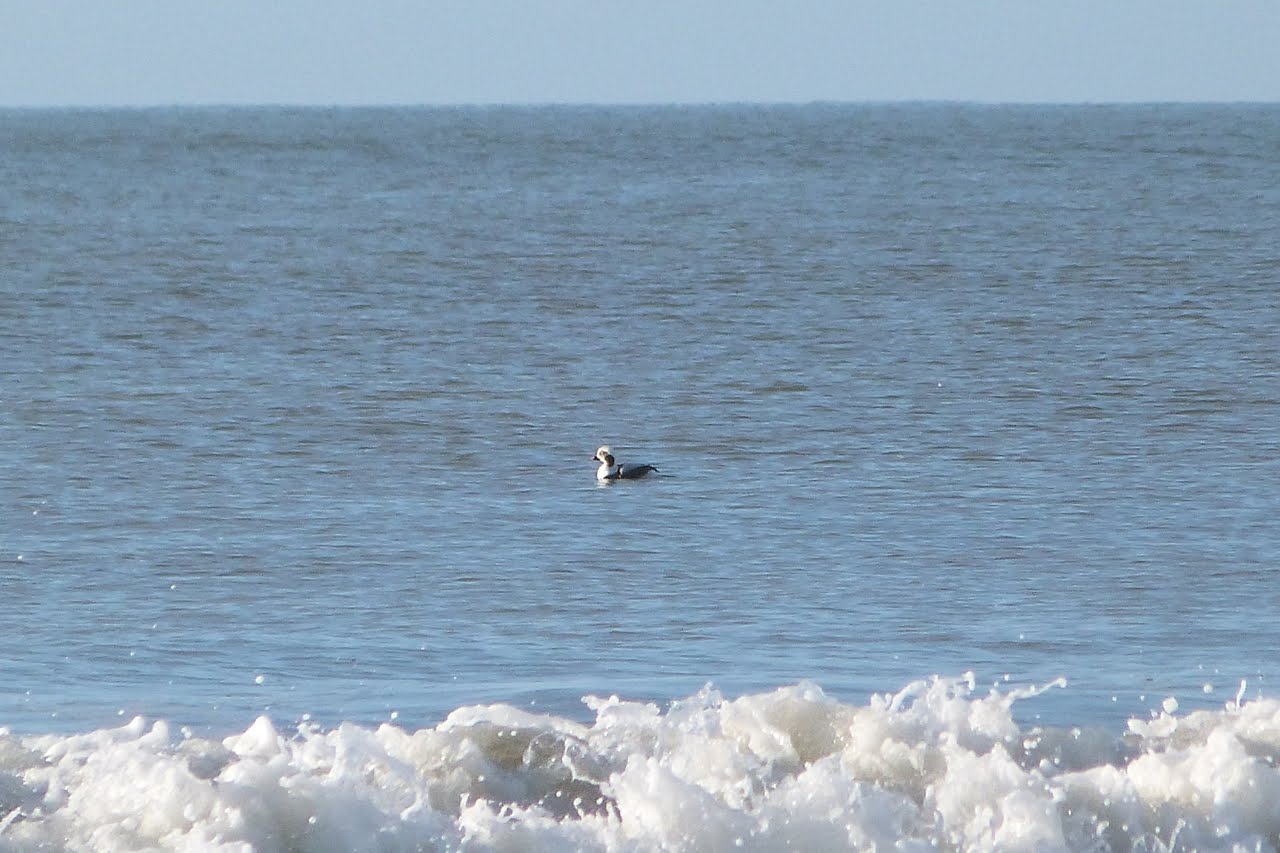
First port of call was the Ynyslas turn 'carpark' where we emerged blinking into the light and watched a rock pipit fly catching on the wooden sea wall. On reaching the wall, the exposed sand in front of us had small groups of feeding sanderling, ringed plover and oystercatcher, which prompted Steffi to grab her camera and adopt her customary belly-crawl technique across the soggy beach to capture them on film. I took the easier, and far more sensible approach, by setting up the scope and scanning the sea, where large rafts of common scoter bobbed around. Failing to find anything unusual amongst them apart from 2 great crested grebes, I checked the tideline and noticed a very close female scoter feeding in the waves - turning the scope on her I was delighted when an equally close male long tailed duck popped up next to her. By now Steffi had returned and fixing on its location, went off again to try and get some pics - not easy in the dipping swell, and the bird was drifting further out with each second, but she at least got some reasonable record shots.


After that treat, we headed to the River Clettwr to walk the embankment to the saltmarsh. Lots of lapwing, teal, wigeon, golden plover, curlew, redshank and snipe along the way, occasionally rising in great swirling flocks, looking fantastic in the late afternoon sunlight. A kingfisher kept zipping up and down the river and a sighting of 3 meadow pipits had us slighty anxious for a spell, with one of them showing obvious white mantle steaks and behaving in different manner to the other two. Thoughts of red throated kept popping into my head, but try as we might, we had to concede it was just a slightly odd looking meadow. The day ended on a high, when retracing our steps back to the car, a two pronged attack took place on the assembled waders with a ringtail hen harrier and a peregrine panicking the flocks.

Saturday, 22 December 2012

teutonic nights and days

A brief visit to Hamburg to see my mum gave me the chance to do some birding for the second time in my home country and for the first time in winter and should therefore have offered me some continental winter delights. Unfortunately, the weather didn't play along and the birds I saw on my journey to Birmingham Airport were almost better than everything I saw in Germany. But that was ok because it was supposed to be a family holiday and not a birding holiday.
Nonetheless, here is a quick account of my days in flat northern Germany. As I left on Sunday, 7 waxwing sat in a tree in Mach wishing me a farewell and from the train just after Caersws I had two groups of whooper swans (a total of 15), goosander on the river and a couple of sparrowhawk later on. The first day in Hamburg we had a shopping day in the city centre but also took the chance to have a wonder around the Botanical Gardens ("Planten un Blomen" for our Low German speakers). Highlights were a common gull, a flock of siskin feeding high up in an alder tree and a great spotted woodpecker.


On the second day we decided to go to a family and childhood favorite, the Duvenstedter Brook Nature Reserve; a 785 ha area comprising of wetlands, bogs, marshy grassland and wet woodland that is famous for its breeding cranes but which unfortunately tend to leave at the end of Nov / beginning of Dec. It rained heavily all day and notable birds were only numerous flocks of goldcrest, a hunting ringtail hen harrier and two sparrowhawk, the second of which came very close when (unsuccessfully) chasing after a marsh tit.
Then on Wednesday we ventured further afield to a lake near Kiel which is supposed to be good for overwintering wildfowl. But as it had been very cold recently in Germany, the big lake was still mostly frozen over with some wildfowl gathering in the open pools. Nonetheless, as it was a dry (but dull) day we decided to do the 5.5 hour trek around it. In the beginning one of the very pale buzzards (same bird on photo) that are found particularly in Northern Germany caught me out and it took me ages to figure out what it is.


About half way around we encountered a great white egret feeding with grey herons and towards the end some fairly tame goldeneye gave a photo opportunity at last, whilst the "pshh, pshh, pshh" sound of the willow tit accompanied us all the way around.


Whilst I was away Dave had an intriguing encounter with a male sparrowhawk which grabbed a stunned blue tit that had flown into the window of the patio and then munched it away in the ash tree. And today I had the delight to finally see a treecreeper from the kitchen window making up his way on his usual tree.

Saturday, 15 December 2012

Knot a lot.......

This morning we popped down to Ynyslas hoping that the high tide (5.4m) and strong southwesterly winds would push exciting birds into the estuary. How wrong were we, unless you consider cormorants and herring gulls exciting. Nonetheless a few bits and pieces made it worthwhile; just the scenery alone with the violent crashing waves and strange muted light made the journey memorable. Best of all on the bird front was a hunting merlin which was probably just as disappointed as we were in the lack of potential prey items. Despite our best effforts we couldn't turn the cormorants and shags into divers although the usual rafts of common scoter were as pleasant as always. A pair of feeding chough and three grey plover (one of which appeared to be ringed) and a knot at least gave me a photographic opportunity and these waders are always a good sight to see.


At least three stonechat were feeding on the tideline near the visitor centre. The lack of birds posing for photos reduced me to taking arty photos of Dave scanning the estuary! On the way home we spotted a flock of about 50 siskin feeding on an alder tree near the Clettwr.
All in all we made the most out of a brief window of opportunity between all rain yesterday and heavy down pours today from midday onwards.


Thursday, 13 December 2012

Oh what a Circus!

After two weeks of inactivity on the blog front, theres no stopping us now. Another crisp, clear day had Steffi up out early to try and get some dipper shots on the Dulas, whilst I stayed tucked up cosy in a big warm bed. She managed good views of the local pair, and was pleased to hear the males liquid trilling song, before the cold forced her to come back home. After breakfast we decided to head up to the impressive broadwater at Tywyn and see what we could find. First thing we saw was the pictured buzzard, watching intently as the chap from the environment agency was busy clearing the built up sludge from the fieldside ditches.


Plenty of lapwing and golden plover kept us entertained on the walk to the water, along with some showy stonechats, song thrush, red kite and wren.


At broadwater itself a little grebe and 3 male goldeneye, looking resplendent in the sunshine, gave us something to look at other than herring and bh gulls. Whilst setting up the scope to check out the goldeneye, a cracking ringtail hen harrier drifted up over the gorse and preceeded to lazily flap its way along the hedgerow, finally drifting out of sight east of the lagoon.


We continued along the waters edge towards the beach, adding dunlin, curlew, wigeon, teal, ringed plover, redshank, snipe, shelduck, grey heron and mute swans to the list. We headed back towards Tywyn along the deserted beach, where the only new addition to the day was oystercatcher and cormorant. Other sightings during the day included kestrel and chough.
Back home an impressive flock of 50 plus redwings were going back and forth from the ash tree to the flood field up until dusk fell, much to the consternation of the local mistle thrush who doesnt seem to like any intruders in the vicinity of his berry rich holly tree.

Wednesday, 12 December 2012

winter loons

Just to catch up: In the last couple of weeks life has got in the way of birding and blogging. But we managed a few interesting sightings. About ten days ago we had two groups of whooper swans in the fields next to the main road between Caersws and Newtown. On the same day we also had the last opportunity to enjoy our local waxwings as they have now eaten all the berries in town and moved on.


Sightings have included a ring-tailed hen harrier from the Mach to Aber train on the 11th at 8.30am hunting over the estuary, three yellowhammers in their regular area, a new bird for the garden list in the shape of five fly-by lapwings, also in the garden we had a pair of bullfinches (not very common in the garden) and a mammal tick when an inquisitive mole popped its head up at the base of the bird feeder one morning.


Today we finally had another day out and went to the Ynyslas Turn carpark to do some diver spotting. It was not successful at first with only two flying red-throated divers but we also saw a close-in group of scoter, a couple of great crested grebes and on the beach sanderling, ringed plover and oystercatcher. I couldn't resist the opportunity to lie down on the wet mudflats for a photographic session as the beautiful winter light was showing off the sanderlings really well.


Determined to get our diver fix, we went south to a place named Wallog and bingo! A group of 40 to 50 red-throats all milling about at the end of the spit. Despite our efforts we could not turn any of them into black-throats. Lovely to see such a big group but not ideal for photos. On the way down to the beach we flushed a handsome woodcock which flew away from us down the path. To finish off the day nicely we stopped at Cors Fochno in the hope of spotting a hen harrier but no such luck for us. But instead we got a hunting peregrine and a male stonechat showing off its colours in the golden evening light.